How we calculate this
- Posts and holes: Quikrete’s method says to dig the hole about three times the post’s width and one third of the post’s overall length deep, then put 6 in of mix under the post. Solving for the post length gives the formula above. Lumber sizes are actual sizes from NIST PS 20 (a 4x4 is 3 1/2 in square).
- Corners and gates: a corner can add a short section, so we add one post per corner (at most one extra). Each gate opening needs a post on both sides, so each gate adds one post.
- Pickets cover the whole run, gates included, since gates are usually faced with the same pickets.
- Rails and waste follow UFP’s Outdoor Essentials guide: 2 rails per section for a 4 ft fence and 3 for a 6 ft fence (we use 3 for anything over 4 ft), and 10% extra pickets, which we also apply to rails and concrete.
Worked example
100 ft of 6 ft privacy fence with 1 gate 4 ft wide, 4x4 posts 8 ft apart:
- Sections: (100 − 4) ÷ 8 = 12, so 12 sections and 14 posts.
- Posts: 1.5 × (6 ft − 6 in) = 8 ft 3 in long, so buy 10 ft posts and cut them down. Holes are 10 1/2 in wide and 2 ft 9 in deep.
- Concrete: 1.46 cu ft per hole × 14 holes, plus 10% = 51 bags of 60 lb.
- Pickets: 1,200 in ÷ 5 1/2 in = 219 pickets, plus waste = 241.
- Rails: 12 sections × 3 rails, plus waste = 40 2x4s.
Before you dig
Call 811 a few business days before you dig. It’s free, and the utility companies mark buried lines. Confirm where your property line is (a survey is cheap compared with moving a fence), and check zoning and HOA height limits. Tall fences catch a lot of wind; in exposed spots or for fences over 7 ft, have a pro size the posts and footings.
Numbers this calculator uses
Every value comes from the data files behind this page. Anything marked PLACEHOLDER hasn’t been checked against a source yet, and you can override it in the calculator where it matters.
| Number | Value | Source |
|---|---|---|
| Tallest fence exempt from a building permitR105.2. Zoning and HOA rules often limit height further. | 7 ft | 2024 IRCchecked 2026-10-30 |
| Post spacing (default)UFP's Outdoor Essentials guide spaces posts 8 ft on center (6 or 8 ft is typical). Closer spacing makes a stiffer fence. | 8 ft | UFP Industries (Universal Forest Products)checked 2026-10-30 |
| Rails per section, fences 4 ft tall or less | 2 | UFP Industries (Universal Forest Products)checked 2026-10-30 |
| Rails per section, fences over 4 ftUFP gives 3 rails for a 6 ft fence; we use 3 for anything over 4 ft. | 3 | UFP Industries (Universal Forest Products)checked 2026-10-30 |
| Fasteners per picket at each rail | 2 | PLACEHOLDER |
| Fence nails per boxGrip-Rite 2 in exterior galvanized coil nails. Match this to the box you price. | 1200 | The Home Depotchecked 2026-10-30 |
| Picket heights sold | 4, 5, 6, 8 ft | PLACEHOLDER |
| Waste factor for pickets, rails and concrete (default; you can change it)UFP recommends adding 10% to the picket count. We apply the same 10% to rails and concrete. | 10% | UFP Industries (Universal Forest Products)checked 2026-10-30 |
| Concrete mix yield per bag | 40 lb: 0.3 cu ft; 50 lb: 0.375 cu ft; 60 lb: 0.45 cu ft; 80 lb: 0.6 cu ft; 90 lb: 0.675 cu ft | The Quikrete Companieschecked 2026-10-30 |
| Post hole width, times the post's width | 3 | The Quikrete Companieschecked 2026-10-30 |
| Post hole depth, as a fraction of the post's overall length | 1/3 | The Quikrete Companieschecked 2026-10-30 |
| Concrete mix under the post | 6 in | The Quikrete Companieschecked 2026-10-30 |
| Actual lumber sizes | 4x4 = 3 1/2 × 3 1/2 in; 6x6 = 5 1/2 × 5 1/2 in; 2x4 = 1 1/2 × 3 1/2 in; 1x6 = 3/4 × 5 1/2 in; 1x4 = 3/4 × 3 1/2 in | National Institute of Standards and Technologychecked 2026-10-30 |
Sources
| Source | What we use from it | Last checked |
|---|---|---|
| QUIKRETE Concrete Mix No. 1101 data sheet (revised October 2022)The Quikrete Companies · manufacturer spec | Bag yields (40 lb 0.30 cu ft, 50 lb 0.375, 60 lb 0.45, 80 lb 0.60, 90 lb 0.675), mixing water per bag, minimum pour thickness of 2 in, control joints every 6 to 8 ft, fence post hole size (3x the post width, 1/3 of the post's length deep, 6 in of mix under the post). | 2026-10-30 |
| Outdoor Essentials Fence Calculator: Building with Pickets (2019)UFP Industries (Universal Forest Products) · manufacturer guide | Posts 8 ft on center (6 or 8 ft typical); 2 rails per section for a 4 ft fence, 3 for a 6 ft fence; posts = sections + 1 per run + 1 per gate; add 10% to the picket count. | 2026-10-30 |
| Voluntary Product Standard PS 20-10, American Softwood Lumber Standard, Table 3National Institute of Standards and Technology · standard | Actual (dressed, dry) sizes of nominal lumber: 1x6 is 3/4 x 5-1/2 in, 5/4 boards are 1 in thick, 2x lumber is 1-1/2 in thick, 4x4 is 3-1/2 in, 6x6 is 5-1/2 in. | 2026-10-30 |
| Southern Pine specification guidelinesSouthern Pine Council · industry guide | Dimension lumber is specified in standard lengths from 8 to 20 ft in 2 ft steps. | 2026-10-30 |
| Grip-Rite 2 in x 0.092 in exterior galvanized ring-shank coil nails, 1,200 per box (GRC6R92HG1), Home Depot listingThe Home Depot · store listing | Fence nails sold 1,200 per box. | 2026-10-30 |
| 2024 International Residential Code, Section R105.2 (Work exempt from permit)International Code Council · building code | Permit exemptions: fences up to 7 ft, retaining walls up to 4 ft (bottom of footing to top of wall, no surcharge), detached accessory buildings up to 200 sq ft, small low unattached decks. | 2026-10-30 |
| 811: the free national call-before-you-dig serviceCommon Ground Alliance · safety service | Contact 811 a few business days before digging so buried utility lines are marked, free of charge. | 2026-10-30 |
Spotted a number that’s out of date? Tell us and we’ll recheck it and note the fix in the change log.
Frequently asked questions
How deep should fence posts be?
Quikrete’s method makes the hole one third of the post’s overall length, with 6 in of concrete mix under the post. For a 6 ft fence that means a 8 ft 3 in post in a hole about 2 ft 9 in deep. Where the ground freezes, go below your local frost depth; your building department can tell you what it is.
How many bags of concrete per fence post?
For a 4x4 post in a 10 1/2 in hole 2 ft 9 in deep, about 1.46 cu ft per hole after subtracting the post: roughly 3.9 bags of 50 lb mix or 2.4 bags of 80 lb mix (Quikrete yields). The calculator works it out for your post size and height.
How far apart should fence posts be?
UFP Industries’ Outdoor Essentials fence guide spaces posts 8 ft on center and calls 6 or 8 ft typical, which is our default. At 8 ft each rail spans one section without a joint. Closer spacing makes a stiffer fence.
How many pickets do I need for 100 feet of fence?
With 1x6 pickets (actually 5 1/2 in wide, per the lumber standard) butted tight: 1,200 in ÷ 5.5 = 218.2, so 219 pickets before waste. Leave a gap between pickets and the count drops; the calculator handles both.
Do I need a permit for a privacy fence?
Under the model building code, fences up to 7 ft tall don’t need a building permit (2024 IRC R105.2). Zoning rules, HOAs and corner-lot sight lines often limit height further, and some towns want a fence permit anyway, so check before you build.
How wide should the post hole be?
About three times the post’s width, per Quikrete: 10 1/2 in for a 4x4 (which is 3 1/2 in wide) and 16 1/2 in for a 6x6.
Save this plan
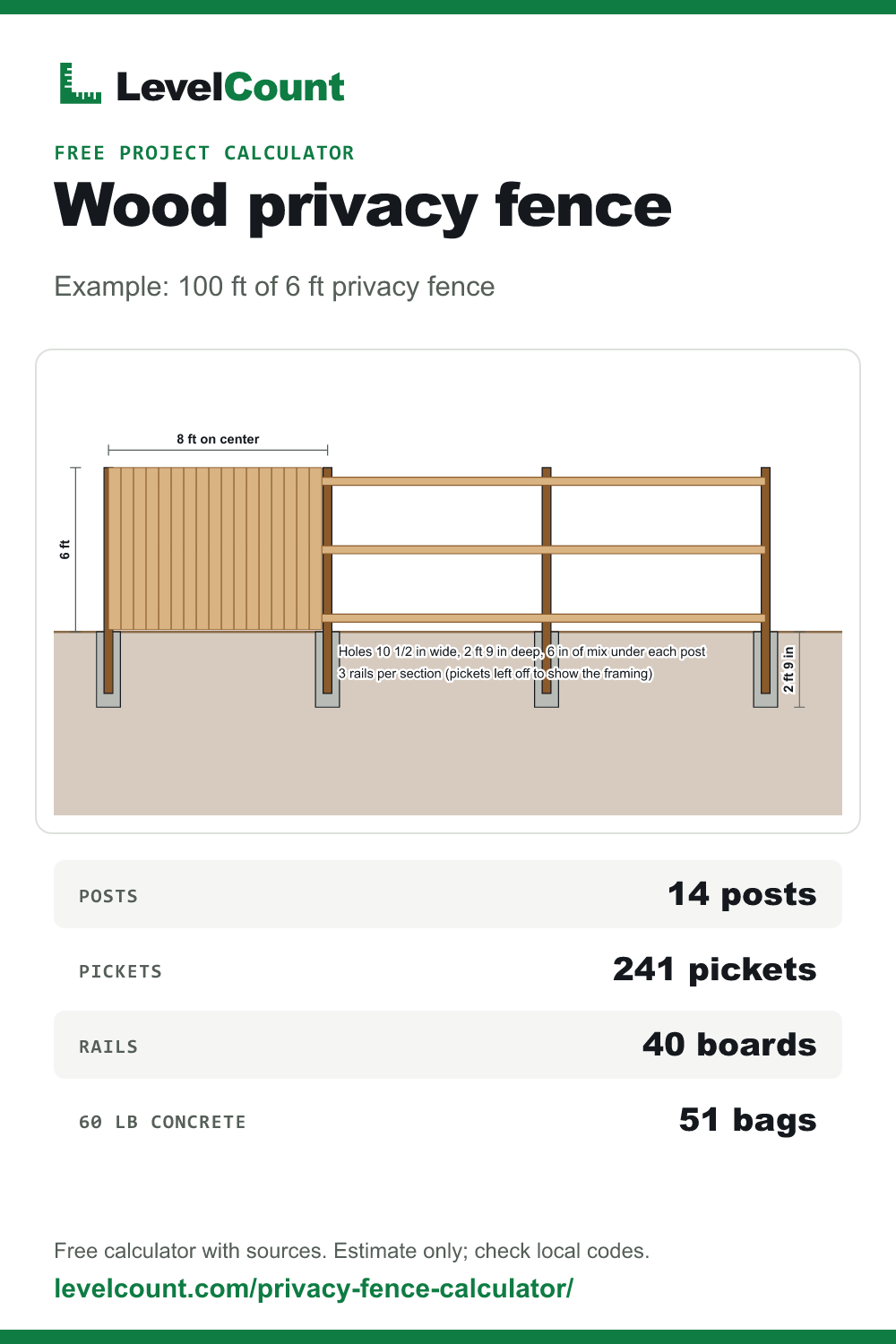
This card shows the example on this page. Use Download summary image above to make one with your own numbers, or pin this one to come back to the calculator later.