How we calculate this
Here e is how far the base runs past the paver edge so the edging sits on compacted gravel: at least 6 in (SEK’s instructions for Snap Edge), or as much as the base is thick if that’s more (CMHA’s rule of thumb for spiked edging). Loose gravel shrinks when you compact it, so we add 15% to the base; ask your supplier for their figure. Gravel is often sold by the ton, so we also show an approximate weight using 1.4 tons per cubic yard. That figure is a placeholder; your supplier knows the real one.
The base depth, sand depth and joint widths are from CMHA Tech Note PAV-TEC-002-22. Polymeric sand uses Alliance Gator’s coverage for 2-3/8 in pavers: 65 sq ft per 50 lb bag for joints up to 3/8 in and 22 sq ft for wider joints (the low end of each range). Edging is Snap Edge’s 8 ft pieces with a spike every 2 ft plus one at each joint, per SEK; driveways and curves need one every foot.
Worked example
A 16 ft × 12 ft patio (192 sq ft) in 4 × 8 in pavers with 1/8 in joints:
- Pavers: 144 ÷ (8 1/8 × 4 1/8) = 4.3 per sq ft. 192 × 4.3 = 825, plus 10% = 908 pavers.
- Base: 221 sq ft (the patio plus 6 in all round) × 4 in = 2.73 cu yd, plus 15% for compaction = 3.2 cu yd.
- Sand: 192 sq ft × 1 in = 16 cu ft, plus waste = 0.7 cu yd.
- Edging: 56 ft of open edge = 7 pieces and 35 spikes.
- Dig: 2 3/8 + 1 + 4 = 7 3/8 in below the finished surface.
Before you dig
Call 811 a few business days before you dig. It’s free, and the utility companies will mark buried lines. Rent a plate compactor rather than hand-tamping a big base, wear hearing and eye protection, and wet-cut or use dust control when cutting pavers: concrete dust contains silica. A patio that will carry a car, sits on a slope, or needs a retaining wall is worth a hardscape contractor’s visit.
Numbers this calculator uses
Every value comes from the data files behind this page. Anything marked PLACEHOLDER hasn’t been checked against a source yet, and you can override it in the calculator where it matters.
| Number | Value | Source |
|---|---|---|
| Minimum compacted base for patios on well-drained soilColder climates and wet or weak soils need a thicker base. | 4 in | Concrete Masonry & Hardscapes Associationchecked 2026-10-30 |
| Bedding sand (uncompacted) | 1 in | Concrete Masonry & Hardscapes Associationchecked 2026-10-30 |
| Narrowest joint between pavers | 1/16 in | Concrete Masonry & Hardscapes Associationchecked 2026-10-30 |
| Widest joint between pavers | 3/16 in | Concrete Masonry & Hardscapes Associationchecked 2026-10-30 |
| Thickest base layer to compact at once (7,000 lbf plate compactor)CMHA: compact in 4 to 6 in lifts; thinner with a lighter compactor. | 6 in | Concrete Masonry & Hardscapes Associationchecked 2026-10-30 |
| Cubic feet in a cubic yard | 27 | Unit definition |
| Base extends past the paver edge (at least)SEK (Snap Edge): at least 6 in past the paved area. CMHA: at least as far beyond the edging spikes as the base is thick. We use the larger of 6 in and your base depth. | 6 in | SEKchecked 2026-10-30 |
| Extra base gravel for compactionLoose gravel shrinks when compacted. Ask your supplier for their number. | 15 % | PLACEHOLDER |
| Weight of crushed base gravelVaries by stone and moisture. Ask your supplier. | 1.4 tons per cu yd | PLACEHOLDER |
| Bagged paver sand volume | 0.5 cu ft | The Home Depotchecked 2026-10-30 |
| Bagged paver base volume | 0.5 cu ft | The Home Depotchecked 2026-10-31 |
| Polymeric sand coverage per 50 lb bag, joints 1/8 to 3/8 inAlliance Gator, 2-3/8 in pavers: 65 to 85 sq ft. We use the low end. | 65 sq ft | Alliance Designer Productschecked 2026-10-30 |
| Polymeric sand coverage per 50 lb bag, joints 3/4 to 1-1/4 inAlliance Gator: 22 to 42 sq ft. We use the low end. | 22 sq ft | Alliance Designer Productschecked 2026-10-30 |
| Widest joint in the narrow-joint coverage range | 3/8 in | Alliance Designer Productschecked 2026-10-30 |
| Edge restraint piece length (Snap Edge) | 8 ft | SEKchecked 2026-10-30 |
| Edging spike spacing (walks and patios)SEK: one spike every 2 ft for walks and patios, every 1 ft for driveways or curves, plus one at each joint. | 24 in | SEKchecked 2026-10-30 |
| Paver thickness (default)CMHA: pedestrian areas and driveways use 2-3/8 in (60 mm) pavers. Use your product's actual thickness. | 2 3/8 in | Concrete Masonry & Hardscapes Associationchecked 2026-10-30 |
| Waste factor for pavers and sand (default; you can change it)Cuts at the edges and broken pieces. Raise it for herringbone or curved layouts. | 10% | PLACEHOLDER |
Sources
| Source | What we use from it | Last checked |
|---|---|---|
| CMHA Tech Note PAV-TEC-002-22: Construction of Interlocking Concrete PavementsConcrete Masonry & Hardscapes Association · industry guide | Minimum 4 in compacted base for patios on well-drained soils (thicker in cold or wet soils), 1 in uncompacted bedding sand, joints 1/16 to 3/16 in, base compacted in 4 to 6 in lifts, edge restraints touching at least 1 in of the paver side. | 2026-10-30 |
| CMHA Tech Note PAV-TEC-003-22: Edge Restraints for Interlocking Concrete PavementsConcrete Masonry & Hardscapes Association · industry guide | Rule of thumb: the base should extend beyond spiked edge restraints at least as far as the base is thick. | 2026-10-30 |
| SnapEdge paver edge restraint brochureSEK · manufacturer guide | 8 ft pieces; gravel base at least 6 in past the paved area; one spike every 2 ft for walks and patios (every 1 ft for driveways or curves) plus one at each joint. | 2026-10-30 |
| Alliance Gator Reference Guide 2025Alliance Designer Products · manufacturer spec | Polymeric sand per 50 lb bag with 2-3/8 in pavers: 65 to 85 sq ft for 1/8 to 3/8 in joints, 22 to 42 sq ft for 3/4 to 1-1/4 in joints. | 2026-10-30 |
| Paver Sand, 0.5 cu ft bag (98000), Home Depot listingThe Home Depot · store listing | Paver sand sold in 0.5 cu ft bags. | 2026-10-30 |
| 811: the free national call-before-you-dig serviceCommon Ground Alliance · safety service | Contact 811 a few business days before digging so buried utility lines are marked, free of charge. | 2026-10-30 |
Spotted a number that’s out of date? Tell us and we’ll recheck it and note the fix in the change log.
Frequently asked questions
How deep should the gravel base be for a paver patio?
CMHA (formed when ICPI and NCMA merged) recommends at least 4 in of compacted base for sidewalks and patios on well-drained soil, at least 6 in for residential driveways, and thicker bases in cold climates or on wet or weak soils (Tech Note PAV-TEC-002).
How much sand goes under pavers?
A nominal 1 in of bedding sand, screeded flat and not compacted before the pavers go down (CMHA). Keep the layer even: fix low spots in the base, not with extra sand.
How wide should the joints between pavers be?
Between 1/16 and 3/16 in, according to CMHA. Most pavers have spacer bars on their sides that set the joint for you. The calculator adds the joint to each paver’s size when it counts pavers per square foot.
How many pavers are in a square foot?
With 1/8 in joints: about 4.3 pavers of 4 × 8 in, 3.84 of 6 × 6 in, 2.58 of 6 × 9 in, and 0.98 of 12 × 12 in. Use your paver’s actual size, which can be a little under its nominal size.
Do I need edging around a paver patio?
Yes, on every edge that isn’t held by a house, wall or slab. CMHA says the restraint should touch at least 1 in of the paver’s side. Enter the length of edge against your house and the calculator leaves edging off it.
How do I compact a thick base?
In layers. CMHA recommends compacting the base in 4 to 6 in lifts with a plate compactor of about 7,000 lbf, and thinner lifts with a lighter machine. The calculator tells you how many layers your base needs at 6 in each.
Save this plan
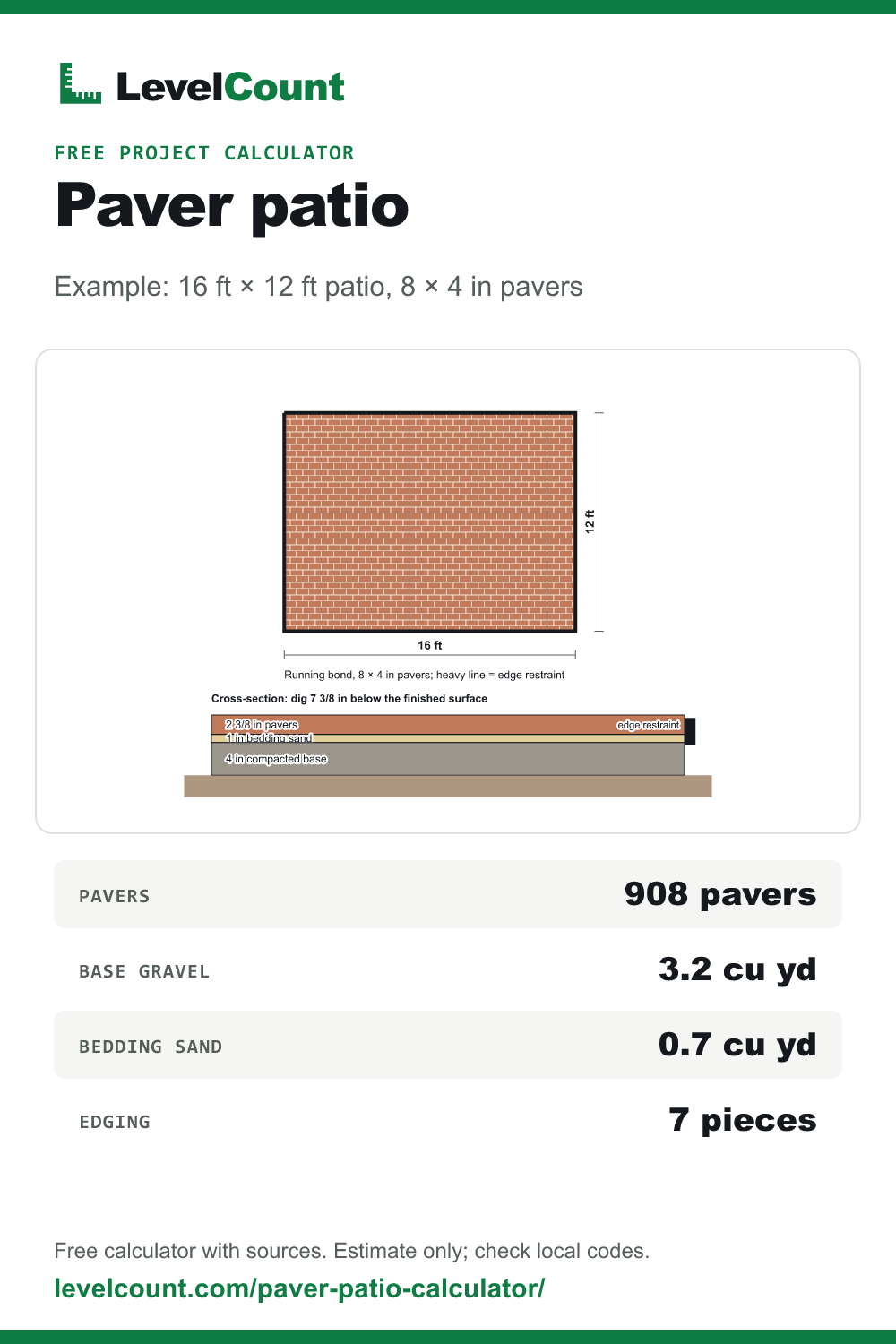
This card shows the example on this page. Use Download summary image above to make one with your own numbers, or pin this one to come back to the calculator later.